
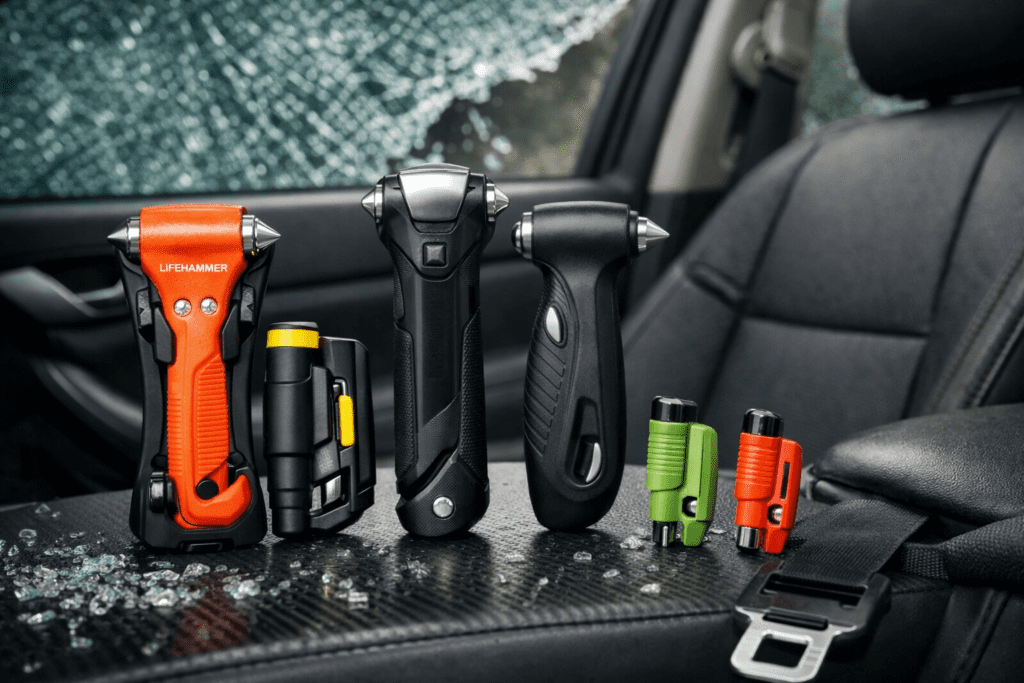
An emergency seatbelt cutter and window breaker is one of those car safety tools that most drivers have never given a second thought to. I get it — it doesn’t feel urgent. You’ve driven thousands of miles without needing one. But that’s exactly the kind of thinking that leaves people unprepared for the one situation where it genuinely matters.
Why Getting Out of Your Car Isn’t Always Simple
We get in and out of our cars without a second thought, dozens of times a week. So, it’s easy to assume that if something went wrong, getting out would be just as straightforward. It often isn’t.
After a serious impact, the door frame can bend jamming the latch shut. A car that comes to rest on its side or upside-down changes everything about what’s reachable. Seatbelts lock under sudden tension by design — which is great for protecting you, but means that after a crash, the buckle can be surprisingly hard to release. And under real stress, even simple tasks become harder than they should be.
A family member of mine found this out firsthand when their car left the road, rolled, and ended up on its roof. Doors jammed. Seatbelt locked. They were trapped. Getting out took far longer and far more effort than it should have. They were fine — but the whole thing could have been a lot simpler with the right tool within reach.
What Is an Emergency Seatbelt Cutter and Window Breaker?
It’s a small, dual-function tool that does two very specific jobs: cuts a jammed or tension-locked seatbelt and breaks a side window when a door won’t open.
The best ones use a recessed, protected blade which is safer to store close at hand than an exposed knife . The blade cuts through seatbelt material in a single motion. The window breaker is typically a hardened steel tip or spring-loaded punch engineered specifically for automotive glass. One focused strike near the corner of a side window is usually all it takes.
Think of it as a backup plan, not a survival gadget. Your car has no built-in solution for a jammed belt or a door that won’t open. This tool fills that gap.
The One Thing Most People Don’t Know — And Really Should
Here’s something that doesn’t make it onto most product pages, but it’s genuinely important: not all car windows respond the same way to a window breaker.
Older model side windows are made from tempered glass, which shatters into small pieces when struck with a focused point. That’s what these tools are designed for, and they work well on it.
But a growing number of newer vehicles, particularly from around 2018 onwards, use laminated glass in their side windows. Laminated glass (the same type used in windshields) cracks but stays bonded together. It doesn’t shatter. And most consumer window breakers won’t get through it.
AAA has tested these tools and found that while they perform well on tempered glass, results on laminated side glass vary significantly — with many tools failing to penetrate. So before you assume you’re covered, it’s worth knowing what type of glass your car actually has.
How to Check What Glass Your Car Has (Two Minutes, Worth It)
Look at the lower corner of any side window. There’s a small etched label — called the “bug” in the glass trade — that shows safety certifications and the glass type. Look for the word “tempered” or “laminated,” sometimes abbreviated to “T” or “L.”
Your windshield will almost certainly be laminated — that’s standard. Side windows are more variable, especially on newer vehicles. If you’re not sure after checking the label, your owner’s manual or a quick call to your dealership will confirm it. Two minutes now could matter a lot later.
What to Look For When Choosing an Emergency Escape Tool
The market is crowded and quality varies. You’re not shopping for the most impressive-looking tool — you’re looking for something that works reliably with one hand, under stress, possibly at an awkward angle. Here’s what actually matters.
Seatbelt cutter
A recessed blade is safer to store and handle than an exposed one. The grip needs to be large enough to hold securely with shaking hands or gloves. And the blade should cut cleanly through thick webbing in a single pull — not drag or snag.
Window breaker
A spring-loaded punch mechanism beats anything that requires a swing — you often don’t have the room. The tip should be hardened steel. Target a side window, not the windshield, and aim for a lower corner where tempered glass is most vulnerable to a focused strike.
Where to Keep It
An escape tool in your trunk is useless. Same with the glovebox — which can jam shut after impact and is awkward to reach when restrained.
The best locations are within immediate reach of the driver: the sun visor clip is ideal, the driver-side door pocket works well, and a mounted clip near the center console edge or knee area is another solid option. The test is simple: close your eyes and reach for it. If you can find it instantly, you’ve got the placement right.
For family cars, consider a second tool in the rear passenger area. Thirty seconds explaining where it is and what it does to your family could be the most valuable safety conversation you have this year.
How to Use It — Keep It Simple
These tools are designed to be used under stress, so the instructions need to be simple enough to remember without thinking. Here’s the sequence:
- Try the buckle first — it may release normally.
- If it’s stuck or locked under tension, use the cutter across the belt, away from your body.
- Try the door. If it won’t open, target a side window — not the windshield.
- Strike near the lower corner with the punch end. Clear the glass and get out.
If the window doesn’t break, it may be laminated glass. Try a rear side window, which is sometimes a different type. And wherever possible, try the door in the first moments after impact, before water pressure or structural damage makes it harder.
Who Should Carry One?
The simple answer is: anyone who drives. But there are situations where it feels especially relevant.
Parents driving with children. Older drivers, for whom physical strength in an emergency may be more limited. Daily commuters — because more time on the road means more exposure. People who regularly drive rural roads, where help is further away. And anyone who drives alone at night.
In each case, the logic is the same as a first aid kit or a spare tire: it’s basic preparedness for something unlikely but not impossible — where being unprepared carries a disproportionate cost.
A Few Things Worth Clearing Up
A couple of misconceptions come up often enough to be worth addressing.
“Any sharp object will break a car window.” Automotive glass is tougher than most people expect. A purpose-built hardened tip concentrates force in a way that improvised objects usually don’t. Testing consistently shows the difference.
“I can just kick the window out.” Sometimes possible. Often not. And in a confined, tilted vehicle, the risk of injury from the attempt is real.
“My car is modern so I’m fine.” Modern cars are safer in a crash. They’re not immune to doors jamming, belts locking, or power failing after impact. If anything, the increasing use of laminated side glass in newer vehicles makes knowing your glass type more important, not less.
FAQs
Does it work on the windshield?
No — and don’t try. Windshields are laminated and won’t shatter. A side window is always your target.
What if my side windows are laminated?
This is exactly why checking matters before you need to. If your side glass is laminated, a standard punch tool may not work — and you should factor that into your emergency planning. Some rear side windows may be tempered even when front side windows are laminated, so it’s worth checking each one.
Is it legal to carry?
Yes, in the vast majority of US states. These are purpose-built safety devices. If you’re in any doubt about your specific state, a quick check is worthwhile.
Do I need one if I have power windows?
Yes. Power windows depend on the vehicle’s electrical system, which can fail after a crash, submersion, or fire. This tool works regardless.
Bottom Line
An emergency seatbelt cutter and window breaker sits in the same category as a spare tire or a first aid kit. It’s not about expecting the worst — it’s about being quietly, sensibly ready for the unexpected.
Buy the right tool. Store it where you can reach it in three seconds. Know what glass your car has. Tell your passengers where it is. That’s ten minutes of your time, and a level of preparedness that most drivers — despite good intentions — simply don’t have.
After seeing firsthand what happens when you need to escape a vehicle in a hurry and the right tool isn’t there — I don’t drive without one.