
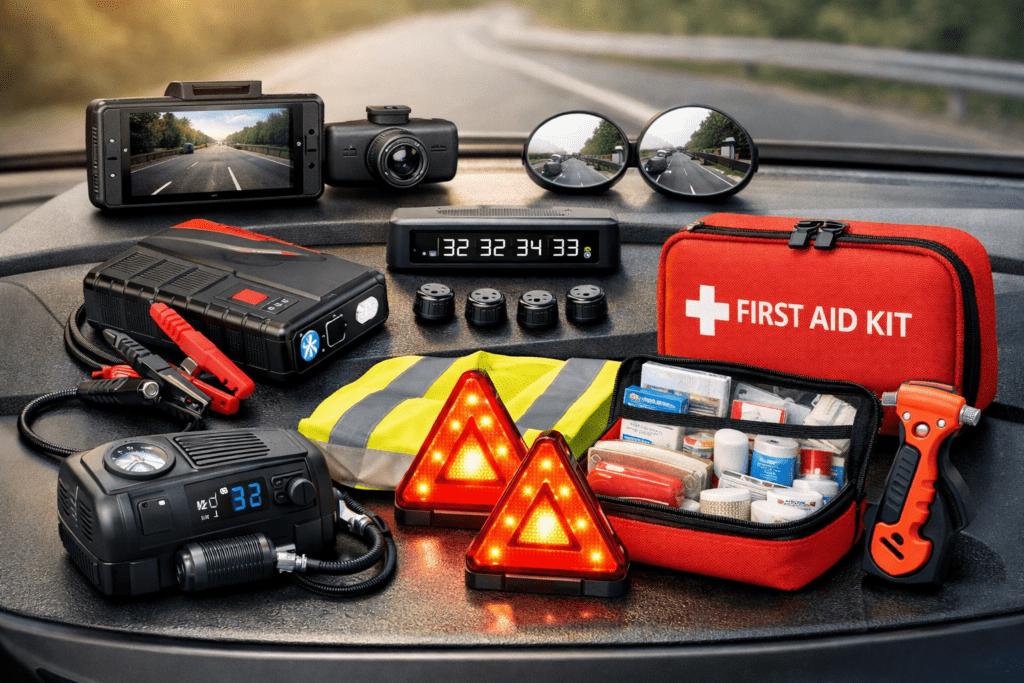
Real safety doesn’t only come from expensive technology that promises to take control in dangerous situations. It also comes from smart, practical tools that expand your awareness, give you better control, and prepare you for those unexpected moments. So, let’s dive in and check out the crucial 8 best car safety gadgets.
How We Chose These Best Car Safety Gadgets
Every item here passed 3 simple tests:
- Clear safety benefits.
- Compatible with the needs of most drivers and vehicles.
- Reliable operation.
If something added risk or distraction, it didn’t make the cut.
8 Best Car Safety Gadgets for Drivers in 2026
1. Dashcam (Front or Front + Rear)
A dashcam isn’t about catching viral footage—it’s about having an unbiased witness when you need one. Insurance claims get resolved faster with video evidence. Disputes about fault become straightforward. And knowing there’s a camera recording tends to make everyone drive more carefully.
Think about what happens at a busy intersection when two cars collide and both drivers swear they had the green light. Without footage, it’s a mess of conflicting stories. With clear video, the truth is obvious.
Look for strong low-light performance, loop recording, 1080p resolution minimum, a secure mount, and heat-resistant power systems.
2. Blind-Spot Mirror Add-Ons
These small convex mirrors show you what your regular mirrors can’t.
Here’s where they are essential: You’re merging onto the highway, you check mirrors, signal, and start to move—then a horn blares beside you. A motorcycle was sitting exactly where your mirror couldn’t catch it.
With a properly positioned blind-spot mirror, you see that rider before you commit to the lane change.
Choose the right size and curve, adhesive that handles extreme temperatures, and take time getting the positioning right.
3. Tire Pressure Monitoring System (Portable TPMS)
Your tires are more critical to safety than most people realize. Think about it – they are your only contact with the road surface. So when tire pressure drops, handling suffers, braking distance increases, and blowout risk jumps.
Picture this: You’re three hours into a road trip when the car feels slightly off. A slow leak has dropped rear tire pressure by 10 psi. A good TPMS would have alerted you an hour ago, giving you time to pull over safely instead of discovering the problem at 70 mph.
Look for accuracy, easy-to-read displays, reliable sensors, and simple pairing you’ll actually use.
4. Portable Jump Starter
A dead battery can leave you stranded where you really don’t want to be stuck. But a quality jump starter means you get moving without waiting for help.
Having been stranded in a remote parking lot, I can tell you, a jump starter is my absolute top choice to carry with me.
Look for enough capacity to actually start your engine, built-in reverse polarity protection, quality clamps, and maintain a charging routine so it’s ready when needed.
5. High-Visibility Safety Vest + LED Road Beacons
If you’re stuck roadside, being seen is critical.
Imagine needing to change a flat tire as the sun sets on a busy road. With cars flying past and visibility dropping, you’re basically invisible.
A bright safety vest makes you impossible to miss, and LED beacons placed behind your car give approaching drivers early warning.
Choose strong reflective material, weather-resistant construction, bright LEDs, and magnetic bases for secure placement.
6. 12V Tire Inflator (Portable Air Compressor)
This pairs perfectly with TPMS—one tells you there’s a problem, the other fixes it on the spot.
When your low-pressure warning lights up, you have options: pull over safely, inflate the tire, then decide if you need a shop visit or if it was just gradual air loss.
Look for an accurate built-in gauge, auto-shutoff, hose length reaching all four tires, proper connector seal, and reasonable inflation speed.
7. First Aid Kit (Car-Specific, Not Just Bandages)
Handling minor injuries immediately makes a real difference.
During roadside repairs, it’s easy to catch your hand on something hot or sharp. Having the right supplies within reach means you can clean it properly, apply antiseptic, and bandage it before dealing with a bigger problem.
Get actual supplies—gloves, gauze, antiseptic, scissors, tweezers—organized so you find what you need quickly. Skip tiny kits. Get something designed for real situations.
But Remember: a car first aid kit is not a substitute for seeking professional medical advice, it is just a stop gap to help prevent things getting worse.
8. Emergency Seatbelt Cutter + Window Breaker Tool
This is your last-resort escape tool for situations you hope never happen.
Seatbelt jammed after impact? Door won’t open and you need to exit through a window? This gives you a way out.
Whether it’s a belt mechanism that locks after collision or a car in water where pressure keeps doors sealed, you need a tool you can reach immediately and trust to work.
Mount it within arm’s reach, choose intuitive design, protected blade for safe handling, and proven punch.
Building Your Complete Car Safety System
Think of these tools as protection layers working together.
Dash cams and blind-spot mirrors prevent problems through better awareness and accountability.
TPMS and inflators keep tires safe—one of your car’s most critical safety components.
Jump starters, visibility gear, first aid, and escape tools give you options when things go wrong.
You don’t need everything at once, but this layered approach prepares you for a wide range of situations.
FAQ About the Best Car Safety Gadgets
What are the best car safety gadgets to buy first?
Start with a dash cam and blind-spot mirrors for incident prevention.
Add a jump starter and tire inflator for roadside reliability.
Build from there based on your driving patterns.
Can safety gadgets become distractions?
Yes, if poorly designed, or not properly located to be ready when you need them.
Where should I store emergency tools so they’re actually useful?
Immediately accessible
Keep seatbelt cutters and window breakers in the center console or door pocket—somewhere you can grab instantly. Similarly keep a high-vis vest close to hand. If you’ve ever had to get out of your car on a busy highway you’ll know the importance of being seen
In the Trunk
Jump starter, inflator, and first aid can go in trunk or back seat, but easily accessible, not buried under bags. Extra high-vis gear including LED road beacons can be deeper in the trunk since you’ll have time to retrieve it.
Do I need all 8, or just a few?
You don’t need everything immediately. Start with two or three you’ll genuinely use—most people begin with a dash cam, high-vis vest, blind-spot mirrors, and if you can afford it get an engine jump starter.
Add others as your budget allows and based on your specific driving situations.
Conclusion: Safety is Built in Layers
The best car safety gadgets aren’t the flashiest or most expensive—they’re the ones you’ll actually use and that work when it matters.
Start with a couple of items addressing your biggest concerns.
Maybe get a dash cam for documentation peace of mind, or a jump starter because you’ve been stranded before. That is what I started with, then built up from there.
Build gradually, choosing tools that fit how you drive. The goal isn’t buying everything tomorrow—it’s creating quiet preparedness that lets you drive with real confidence.