
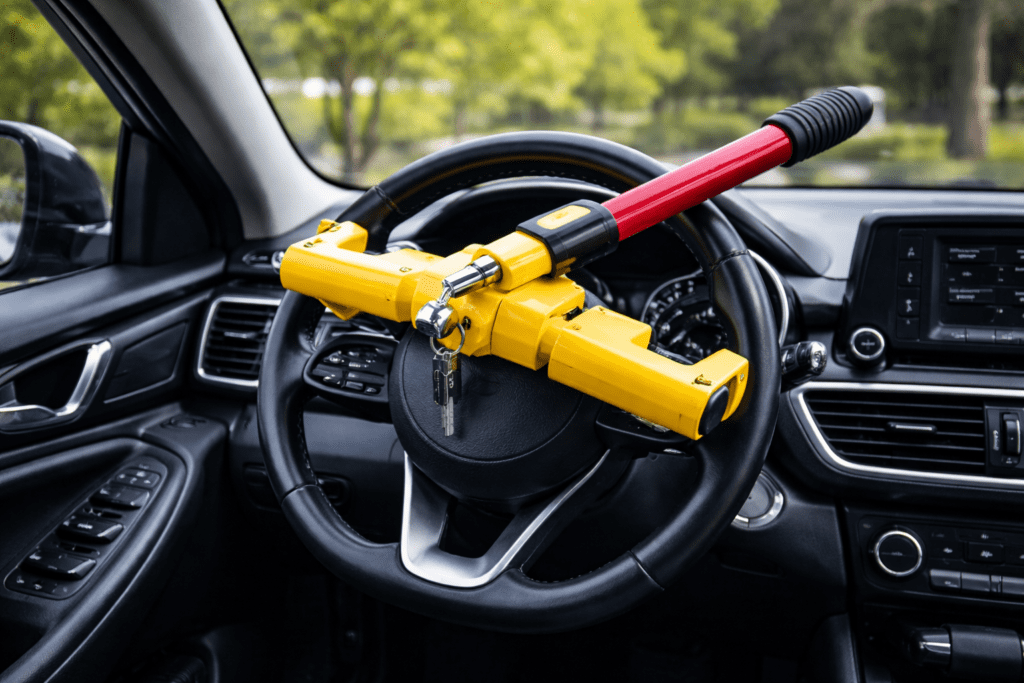
Car theft hasn’t gone away — if anything, it’s evolved. While modern vehicles come loaded with digital security features, a surprisingly large number of thefts still come down to opportunity and speed. That’s exactly where a steering wheel lock earns its place.
In this guide we’ll go over what a steering wheel lock actually does (and doesn’t do), when it makes the most difference, how to use one correctly, and the honest pros and cons so you can decide if one belongs in your car.
What Is a Steering Wheel Lock?
A steering wheel lock is a physical, mechanical anti-theft device that clamps onto your steering wheel to restrict its movement. Most designs are a hardened steel bar or disk that spans the wheel and locks in place, making it impossible — or at least extremely difficult — to steer the car normally.
The core idea is simple: make your car a harder and slower target than the one parked next to it.
They come in a few main forms — more on that below — but what they all share is that they’re visible, physical, and require no complicated installation, wiring, or subscription.
How a Steering Wheel Lock Protects your Car
When a thief breaks into a car, their priority is usually to get gone — fast. A steering wheel lock throws a wrench into that plan in two important ways.
First, it physically prevents the wheel from turning more than a few degrees. Even if someone starts the engine (by hotwiring or relay attack), they can’t drive away in a straight line. Second — and this is often underestimated — it’s visible. A would-be thief can spot it through the windshield before they’ve even tried the door handle.
That visibility is part of the deterrent. Most car thieves are just looking for the easiest target. When they see a steering wheel lock, the calculation becomes: this will take longer, make more noise, and draw more attention. The car next to it probably doesn’t have one.
But remember, it won’t:
- Stop a determined, well-equipped thief who has time and tools
- Prevent a break-in or window smash
- Replace an alarm, immobilizer, or GPS tracker
Think of it as a delay and a deterrent, not a guarantee.
Why Steering Wheel Locks Still Matter in 2026
You might wonder whether a mechanical device still makes sense when modern cars have immobilizers, key fob encryption, and app-based tracking. Fair question. Here’s the thing: many thefts — especially relay attacks on keyless entry vehicles — can bypass digital security entirely. A steering wheel lock is completely independent of your car’s electronics. It can’t be hacked or signal-jammed.
They’re particularly worth considering in these situations:
- Street parking and commuter lots, where your car sits unattended for hours
- Older vehicles that lack modern immobilizers
- Travel, hotel parking, and unfamiliar neighborhoods
- “Quick stop” moments — the gas station, the gym, the coffee run — when most people skip any security step
that last one is worth thinking about.
A huge number of car thefts happen during those short stops where the owner thinks, “I’ll only be two minutes.”
That is where a steering wheel lock, that’s already a habit to use, comes in. That habit is more valuable than any device you leave on the passenger seat.
Benefits of Using a Steering Wheel Lock
It’s a Strong Visual Deterrent
Thieves generally pick the easiest target available. A bright, visible bar across your steering wheel signals effort required — and most opportunistic thieves will move on.
No Installation, No Subscription
Clip it on, lock it, done. There’s no drilling, no wiring, and no monthly fee. It works on any day, in any parking lot, without needing your phone or an internet connection.
It’s a Low-Cost First Layer of Security
For less than the price of a tank of gas, you get a meaningful addition to your vehicle security setup. It’s not a complete solution on its own, but as part of a layered approach it adds genuine friction.
It Complements Everything Else You Already Have
Alarms, GPS trackers, immobilizers, OBD port covers, dash cams with motion alerts — a steering wheel lock stacks on top of all of these. Each layer makes your vehicle a less attractive target and slows a thief down if they get past the previous one.
The Honest Downsides (Because You Should Know These)
No security device is perfect, and a steering wheel lock is no exception. Here’s what to keep in mind before you buy.
A Determined Thief Can Still Remove It
With the right tools and enough time, a steering wheel lock can be cut or forced off. It’s a barrier, not a vault. The goal is to make your car take longer to steal, not to make it impossible.
It Needs to Be Stored Somewhere When You Drive
Steering wheel locks aren’t small. When it’s off the wheel, it has to live somewhere — usually the trunk or back seat. That’s a minor inconvenience for some, a genuine annoyance for others. Think about whether you’ll actually use it consistently before buying.
Fit Can Vary
Steering wheels vary in diameter, thickness, and shape — and some vehicles have controls, paddles, or airbag covers that affect how well a lock sits. Make sure you check compatibility with your specific vehicle before buying.
The Best Lock Is the One You Actually Use
Consistency is everything. A steering wheel lock sitting on your back seat does nothing. If you’re going to use one, commit to the habit — especially for those “quick” stops where skipping it is most tempting.
Steering Wheel Lock Types: A Quick Overview
There’s no single “best” type — it depends on your vehicle, your routine, and what you’ll actually stick with.
Bar-Style Locks
The most common type. A hardened steel bar extends across the wheel and locks at each end. They’re highly visible, generally robust, and work on a wide range of vehicles. The trade-off is size — they’re bulkier to store.
Disk-Style Locks
A solid disk (or partial disk) that covers the center of the wheel and locks in place. These tend to be more compact and faster to fit, though visibility through the windshield varies by design.
Locks with Built-In Alarms
Some models include a motion-triggered alarm that sounds if the wheel is moved or the lock is tampered with. The added noise element increases deterrence — just be aware of battery life and the occasional false alarm in windy or high-traffic areas.
| Quick Tip: Choosing the Right Type Prioritize visibility and ease of use over complexity. The lock you find quickest to fit is the one you’ll actually use every day — and that consistency matters more than the specific model. |
How to Use a Steering Wheel Lock Correctly — and What to Avoid
Using one properly takes about 30–60 seconds once you’ve done it a few times. Here’s the routine:
- Turn the steering wheel to a position where the lock will sit without fouling any other controls.
- Park, switch off the ignition, and take your keys or fob with you.
- Place the lock so it’s clearly visible through the windshield. The visual deterrent only works if someone can see it from outside.
- Lock it snugly, but don’t force it. Forcing a lock against controls or trim can cause scratches or damage over time.
- Give it a quick tug to confirm it’s actually engaged. It should not slide or rotate freely.
- Store your key somewhere safe — and keep a spare somewhere safe. Losing the only key is a headache you don’t need.
A few common mistakes to avoid:
- Putting it on loosely so it can slide around — if it moves freely, it’s not restricting anything.
- Positioning it low, where it’s hidden behind the dash and loses its deterrent value.
- Forcing it against airbag covers, paddle shifters, or other controls.
Frequently Asked Questions
Do steering wheel locks work on push-to-start cars?
Yes. The lock attaches to the wheel itself, not the ignition system, so it works regardless of whether your car uses a traditional key or a push-button start. Relay attacks that fool keyless entry systems can still start your car — but they can’t steer it past a steering wheel lock.
Can a steering wheel lock damage my car?
Not if used correctly. The risk of interior damage comes from forcing the lock against buttons, trim, or airbag covers, or from careless placement. Take a few seconds to position it properly and you won’t have an issue.
Is it worth it if I already have an alarm?
Yes — for two reasons. First, alarms are frequently ignored by bystanders (and even car owners nearby). Second, a steering wheel lock is a physical barrier that works even if a thief disables or bypasses your alarm. They target different attack methods and work better together than either does alone.
How long does it take to put on and remove?
Once you’ve practiced, under 30 seconds each way. The first few times feel awkward; after a week it’s muscle memory.
Are steering wheel locks legal in the US?
Yes, they’re completely legal to use in all 50 states. They’re a standard anti-theft tool sold openly at auto parts retailers nationwide.
Conclusion: A Simple Habit That Earns Its Place
A steering wheel lock won’t make your car unstealable. Nothing will stop a professional car thief who is determined to take your car. But that’s not really the point. The point is making your vehicle a slower, more visible, more effortful target than the alternatives around it — and most thieves will move on.
The formula that actually works isn’t complicated: pick a lock that fits your car and routine, use it every time (especially for the “quick stops”), and pair it with at least one other layer — whether that’s an alarm, a GPS tracker, or simply parking in a well-lit area.
Security is about habits as much as hardware. A steering wheel lock you use consistently beats a sophisticated system you leave at home.utside you need to know you can clear the windshield of your car. First time you use this ice scraper you’ll know you chose well.